

The ABS releases estimates of Employee Earnings annually, using statistics from their Characteristics of Employment survey. Current data is available from August 2014 to August 2024 and tracks the distribution of weekly and hourly employee earnings - by State, Occupation group, and Industry.
This article looks at data for the Health Care and Social Assistance Industry, and the following Occupation groups: Health Professionals, Health and Welfare Support Workers and Carers and Aides.
For more information on ABS Employee Earnings methodology, as well as the other earning series available from ABS sources, such as the biannual Average Weekly Earnings and two-yearly Employee Earnings and Hours, please refer to the ABS Earnings guide.
Australian Health Care and Social Assistance Industry, Employee Earnings Summary, Aug 2024 data:
Earnings estimates for the Health Care and Social Assistance Industry have declined slightly year-on-year, with median weekly earnings down -0.47%, and hourly earnings down -1.43% (see Table 1). However, this follows a period of strong earnings growth: median weekly earnings rose by 8.35% from Aug 2022 to Aug 2023, 9.07% from Aug 2021 to Aug 2022, and hourly earnings increased by 12.6% from Aug 2019 to Aug 2020. The only other decline in the dataset, which spans back to Aug 2014, occurred from Aug 2020 to Aug 2021 (-0.35%). These trends suggest that while earnings growth has generally been stable, the pandemic has disrupted this consistency, and recent growth remains subdued after previous high gains.
In Aug 2024, the Northern Territory had the highest median weekly earnings ($1540) and Tasmania the lowest ($1,161), however, this doesn’t take into account the proportion of part-time and full-time workers. The Australian Capital Territory also saw higher weekly and hourly earnings compared to the other States.
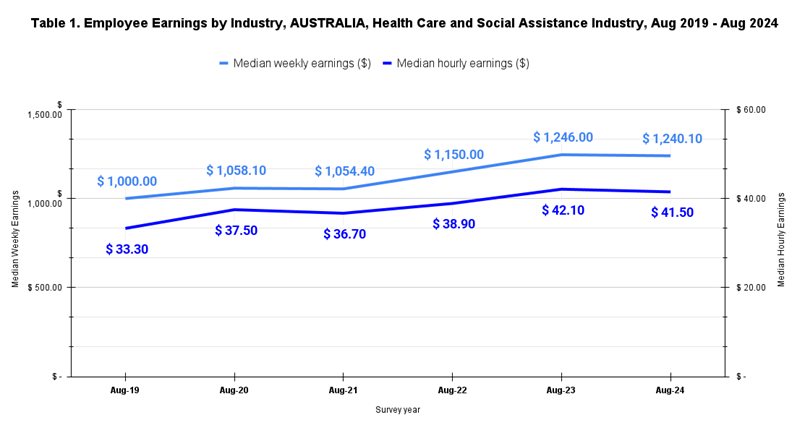
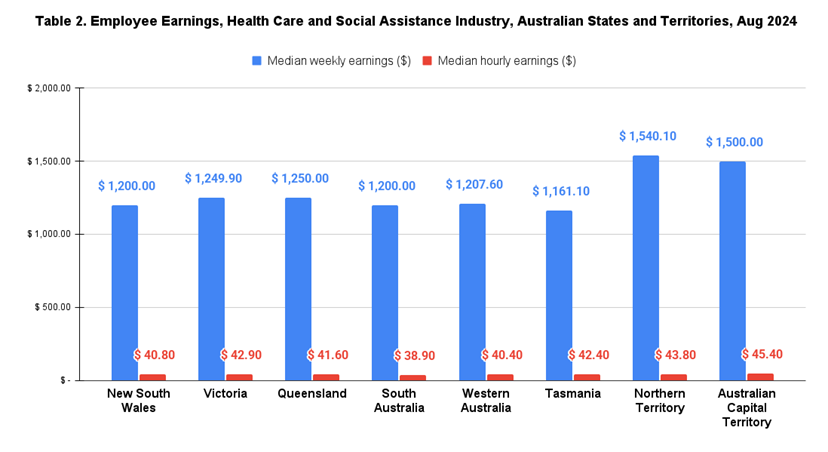
Table 1 and 2 notes and sources: ABS, Employee Earnings - data downloads, Employee Earnings, Table 3 - Distribution of earnings for employees by industry > filtered by: Health Sector Occupations, Total Employees (eg. with and without Leave Entitlements), Classification and Category TOTAL, Aug 2019 – Aug 2024. *Please note ABS measure errors and methodology.
Australian Health Sector Occupations, Employee Earnings Summary, Aug 2024 data:
Employee earnings estimates for Health Sector occupation groups revealed mixed trends. Median weekly earnings increased year-on-year for Health Professionals (+1.44%), Health and Welfare Support Workers (+3.82%), and Carers and Aides (+5.03%). However, median hourly earnings declined across all groups, indicating that workers may be putting in more hours to achieve higher weekly earnings. This suggests potential shifts in employment patterns, such as more workers transitioning from part-time or casual roles to full-time positions, or an increased reliance on overtime or shift work, leading to higher weekly earnings despite stagnant hourly rates.
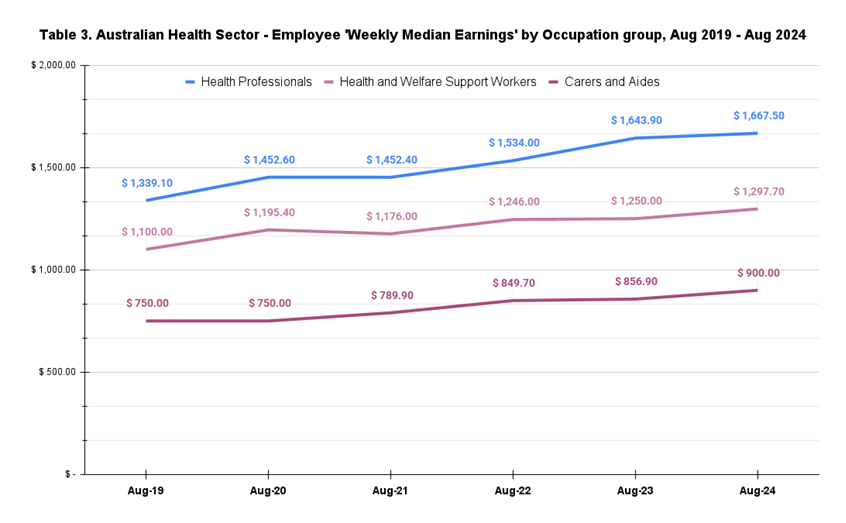
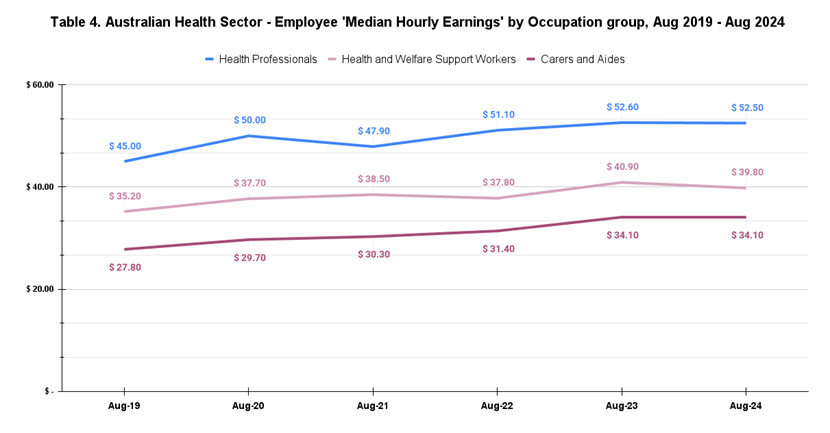
Table 3 and 4 notes and sources: ABS, Employee Earnings - data downloads, Employee Earnings, Table 4b - Distribution of earnings for employees by occupation (detailed) > filtered by: Healthcare and Social Assistance, Total Employees (eg. with and without Leave Entitlements), Classification and Category TOTAL, Aug 2019 – Aug 2024. *Please note ABS measure errors and methodology.
Analysis and commentary © 2025 Health and Medical Pty Ltd.


